
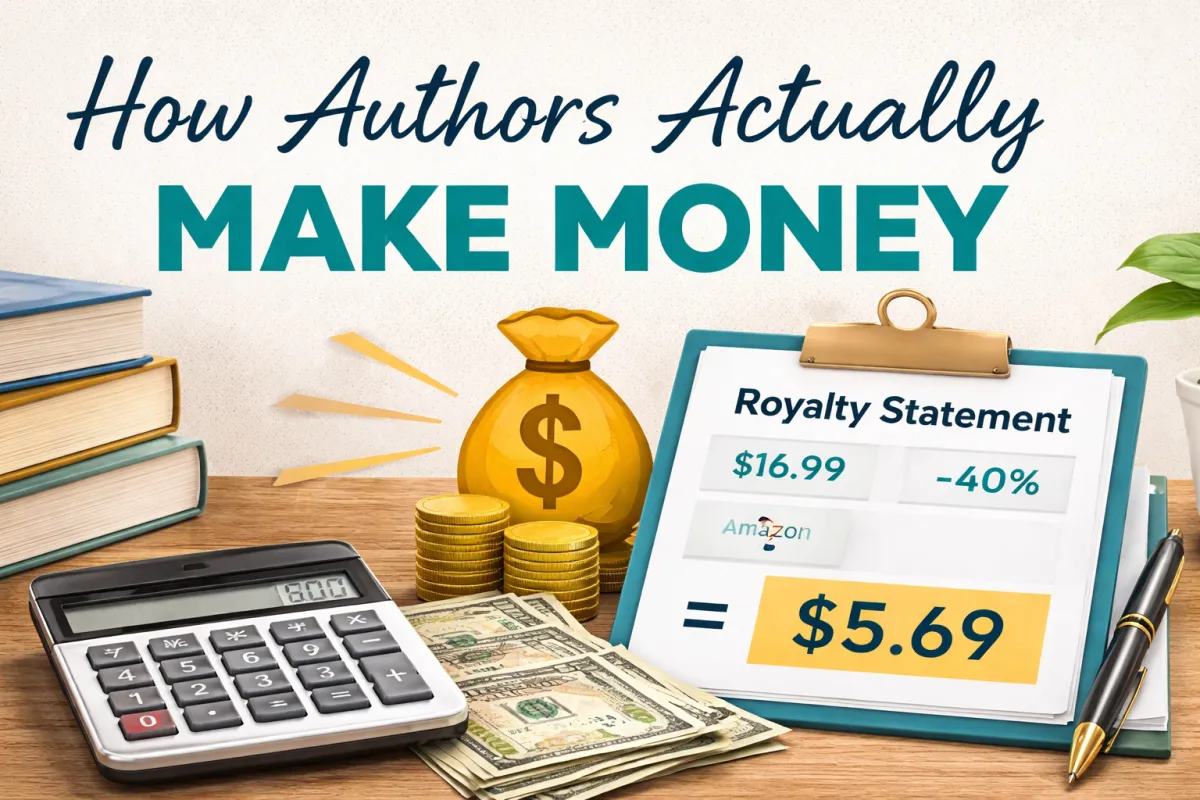
How Authors Actually Make Money (And What Most Writers Earn)
Most authors earn money from multiple sources, not just book sales.
Common income streams include:
Book royalties
Speaking engagements
Teaching workshops
Freelance writing or journalism
Online courses
Coaching or consulting
Membership communities or newsletters
For many writers, the book becomes a platform builder that leads to additional opportunities.
The Dream vs. The Reality
It seems everyone wants to write the Great American Novel and become a wildly successful author.
The reality?
Very few authors become wildly successful financially.
Writing is a career where you must love the entire journey — the writing, the editing process, the business side, and eventually becoming what many call an authorpreneur.
And even then, success must be defined carefully.
For some writers, success means seeing their name on a book cover.
For others, it means reaching readers who need their message.
For a few, it becomes a thriving career.
Understanding the financial side of publishing helps set realistic expectations.
The Reality of Book Sales
Many aspiring authors imagine selling thousands of books immediately.
However, industry data tells a different story.
Some publishing estimates suggest the average traditionally published book sells around 3,000 copies over its lifetime.
Income surveys from the Authors Guild show that many writers earn modest income from books alone and often supplement their income through other writing-related activities such as speaking, teaching, or journalism.
In other words, book sales alone rarely sustain an author’s career.
That’s why many writers develop multiple income streams.
How Many People Actually Read Books?
Another interesting perspective comes from research on reading habits. According to the Pew Research Center, about 23% of U.S. adults reported not reading a single book in the past year, while the typical American reads only a handful of books annually.
This statistic highlights an important reality for authors.
You’re not just competing with other books — you’re competing with busy schedules, streaming services, social media, and countless other demands on people’s attention. That’s one reason building visibility and a reader connection is so important for authors today. It also reinforces why successful writers often think beyond a single book and develop multiple ways to reach readers, such as articles, speaking engagements, workshops, and online content.
This is why successful authors today often think like entrepreneurs, building visibility and connection with readers long before a book ever reaches the shelves.
How Many Books Are Published Each Year?
Another factor authors should consider is competition.
According to data tracked by Bowker, more than one million new books are self-published every year in the United States alone, in addition to the thousands released by traditional publishers.
That means every new book enters a very crowded marketplace.
But it also highlights something encouraging authors who build relationships with readers, develop visibility, and think strategically about their message stand out far more easily than those who simply publish and hope to be discovered.
Knowing Your “Why” Before Counting Your Ducks
Before thinking about money, it helps to ask an important question:
Why are you writing?
Not everyone will become the next James Patterson or Stephen King — although some will certainly be quite successful.
Many writers publish books for meaningful reasons such as:
As a hobby
As a legacy project
To strengthen their professional résumé
To share an important message
To accomplish a lifelong bucket-list dream
Seeing your name printed on a book cover in a bookstore? That’s a pretty special moment too. Understanding your “why” helps guide the decisions that follow.
Publishing Is an Investment
Earlier we explored the question many authors ask first:
How much does it cost to publish a book?
The answer varies depending on your publishing path — traditional, self-publishing, or hybrid — and the professional services involved.
But once a book is published, a new question emerges:
How does the author actually earn money from it?
That’s where understanding royalties, book sales, and additional income streams becomes essential.
Let’s look at a simple example.
Let’s Do the Math
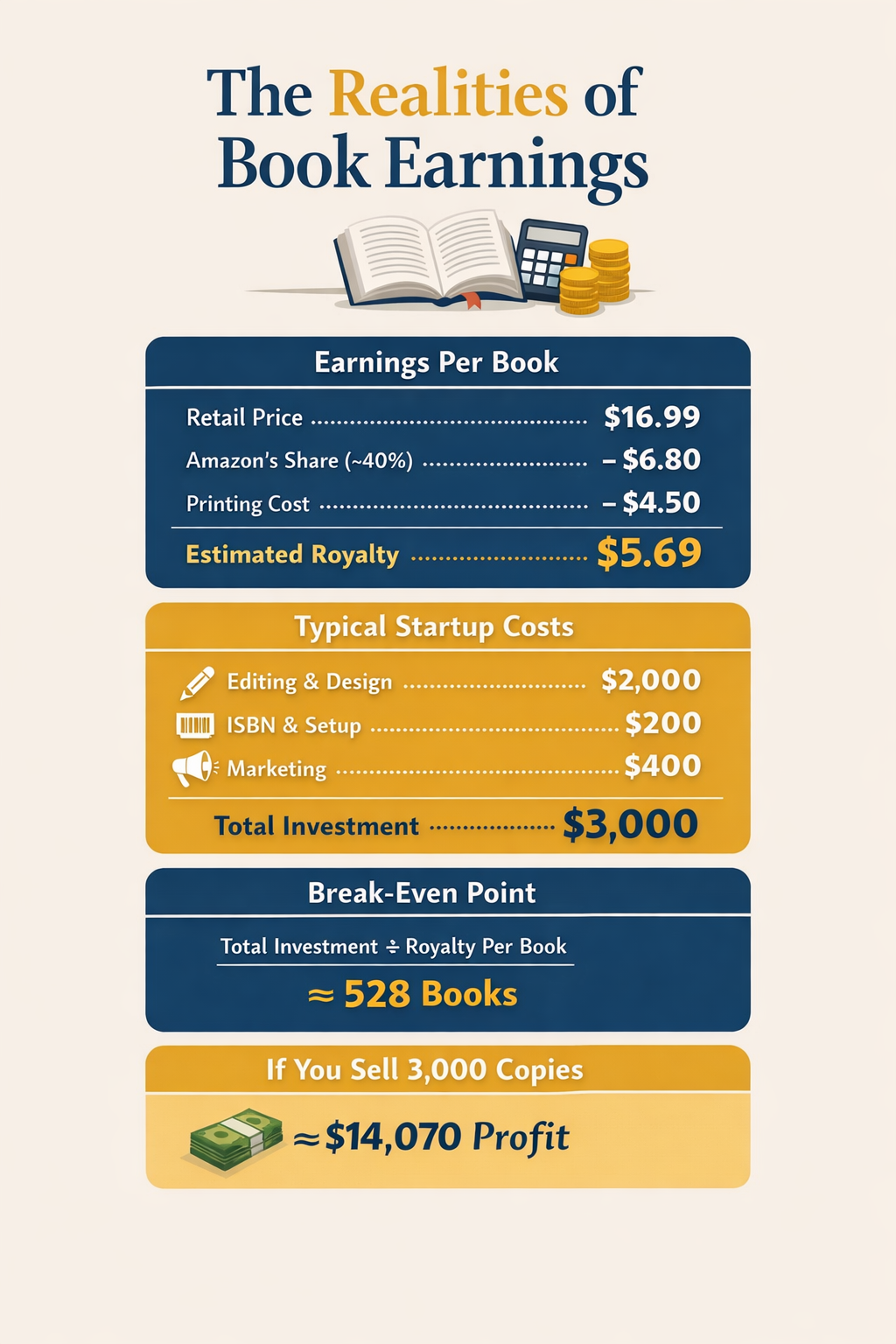
Let’s look at a realistic example.
Imagine you write a 50,000-word book. That’s a common length for nonfiction or a short novel, and it might take one to two years to research, write, and edit.
Now suppose the book sells on Amazon for $16.99.
Example: What an Author Might Earn Per Book
Item Example Amount
Retail price on Amazon: $16.99
Amazon distribution share (~40%) - $6.80
Printing cost (approx. 200-page paperback) - $4.50
Estimated royalty per book $5.69
Startup Costs Example
Expense Estimated Cost
Content / Development Editing $1,500
Cover Design $500
Interior Layout / Formatting $400
ISBN & Setup Costs $200
Initial Marketing $400
Total Investment $3,000
Break-Even Calculation
Calculation Result
Total investment $3,000
Royalty per book $5.69
Books needed to break even ≈ 528 books
If the Book Sold 3,000 Copies
Calculation Result
Royalty per book: $5.69
Copies sold: 3,000
Total royalties: $17,070
Minus startup costs: $3,000
Estimated profit: $14,070
Spread over two years of writing and publishing, that works out to roughly $7,000 per year before taxes.
This example helps explain why many authors diversify their work across several income streams.
Articles and Short-Form Writing
Books are not the only way writers share their message.
Many authors also write:
magazine articles
blog posts
devotionals
guest columns
online publications
Sometimes these pieces are written for free in order to build credibility and visibility.
Other times they are paid opportunities.
Articles often reach larger audiences much faster than books do. A magazine article can reach thousands — sometimes hundreds of thousands — of readers within weeks.
For many writers, articles become an important steppingstone for building a platform.
The Authorpreneur Mindset
Writing a book is a creative achievement.
But building a career as an author requires thinking like an entrepreneur.
Successful authors learn to combine:
✔ creativity
✔ persistence
✔ strategic planning
✔ audience building
This mindset — becoming an authorpreneur — is what transforms writing from a hobby into a long-term opportunity.
Chart Your Next Step
If you’re beginning your writing journey, consider this question: What role do you want your book to play in your life or career?
Understanding that answer can shape the direction of everything that follows.
Because writing a book isn’t just about finishing the manuscript.
It’s about discovering where the journey might lead next. That’s why understanding how to start an author business is such an important next step.
Frequently Asked Questions About Author Income
How much money does the average author make?
Income varies widely depending on the type of publishing and how an author markets their work. Surveys from the Authors Guild show that many writers earn modest income from book sales alone and often supplement their income through speaking, teaching, consulting, or freelance writing.
How many books does the average author sell?
Industry estimates suggest that the average traditionally published book sells around 3,000 copies over its lifetime, although many sell fewer. Successful authors often build additional opportunities around their books to increase overall income.
Can authors make a full-time living from writing?
Yes, but most full-time authors develop multiple income streams such as book sales, speaking engagements, workshops, coaching, courses, and freelance writing.
Do self-published authors make more money?
Self-published authors typically earn higher royalties per book, but they also pay for editing, cover design, printing, and marketing. Traditional publishing may provide wider distribution but usually offers smaller royalties.
Are you writing primarily for legacy, impact, career growth, or personal fulfillment?
Explore More Author Business Guides
If you're navigating the business side of writing and publishing, these resources from the Authorpreneur Compass may help:
• How to Start an Author Business (Not Just Write a Book)
• Traditional vs Self-Publishing: Which Is Right for You?
• How Much Does It Cost to Publish a Book?
• How Authors Actually Make Money
• Do Authors Really Need an Author Business Plan?
• 7 Things Every Author Needs Before Publishing a Book